Pages

Tampilkan postingan dengan label photo. Tampilkan semua postingan

Selasa, 04 Februari 2014

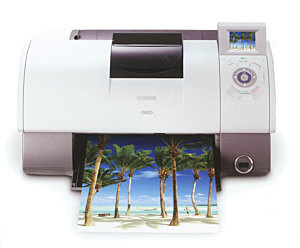
Canon i900D Photo Printer Review

Introduction
The i900D was introduced by Canon in September 2003 and I first saw one in action at the Photo Plus Expo show in New York in October. Canon kindly loaned a sample to photo.net for review and this article is the result. Rather than run the printer though a series of lab test and describe every option and every software screen, I though a better way to review it was to actually use it in the same way a typical purchaser might. Is it easy to assemble? Is the software easy to install and use? Does it make good prints? How long does the ink last? Finally of course, are there any problems or things that have been left out that shouldnt have been. Read on and Ill try to answer these questions.
Canon i900D Technical Specifications
A full listing of all the technical specifications can be found on the specs page. You can also download copies of the printer manuals in PDF format directly from Canon if you want a full technical description of all hardware and software options.
Briefly here are the major features:
Photo printer using 6 ink system
Inks individually replaceable
User replaceable print head
Built in memory card reader and LCD screen
Printing directly from memory card
Printing directly from compatible digital cameras
Borderless printing option
Setup
To properly test setup I tried the method most likely used by the average consumer. Dive into the box and start putting things together. Only read the instructions as a last resort. Turns out mechanical assembly of the printer was quite simple. After removing several hundred (well, maybe a dozen) strips of orange tape holding parts in place all that was required was first to open the package containing the print head assembly, insert it into the printer and lock it into place. Simple. Then open each one of the 6 ink cartridge packets and snap each one into its correct slot (all of which are labeled). The only thing here is to make really sure you put the right color ink in the designated (and clearly labeled) slot. If you put your yellow ink in the magenta slot, your prints will look very strange, and it will take you forever to flush the incorrect color ink out of the system.
The only other assembly required is to attach the 4x6 paper holder to the printer if you want to load 4x6 paper at the same time as 8.5x11 paper . Takes 5 seconds as it more or less just drops in place.
At this point you can plug the printer in, load some paper, stick a memory card in the slot and make a print! No PC or camera required. Theres a small (2") LCD to tell you what to do (though reading the instruction manual isnt a bad idea). You can select an image, select a paper size, crop if necessary, chose from a few printing options and make your print.
I installed the supplied software on a PC running Windows XP. The most important thing here is that you need to install the software BEFORE you attach the printer. If you dont, XP will recognize new hardware and attempt to install its own drivers for what it thinks youve just attached. This should be avoided. All you need to do is first load the software CD and follow the instructions to load the printer driver and the memory card driver. When thats all done, THEN you can attach the printer, XP will recognize new hardware and it will use the Canon drivers which you have just loaded to control it.
There were no bugs during installation. Everything went along as the manual indicated it should.
Memory card reader
The i900D has a built in memory card reader that can either be used to transfer data to a PC via the USB link, or the printer can directly print images which are stored on the card. Its compatible with Compact Flash, Microdrives, Smart Media, SD cards and Multimedia cards. Direct printing from the card supports JPEG (DCF/CIFF/EXIF 2.3 or earlier /JFIF), TIFF (EXIF compliant) and DPOF compliant. It does not support Canon RAW files, these have to be externally converted to JPEG or TIFF before they can be printed.
Time to transfer 30 files (94MB) from a Viking 512MB CF (speed not specified) card in the i900D to an HP Pavilion a230n (AMD 2800+) was 150s, giving a transfer speed of 626 kBytes/s. For comparison, the built in card reader in the a230n (which is USB connected also) took 90s for the same transfer, a speed of 1.04 MBytes/s. These numbers no doubt reflect limitations due to the maximum read speed of the CF card rather than the USB maximum data transfer rate. The USB interface itself if 2.0, theoretically capable of up to 400 megabits/s data transfer.
If you dont already have a memory card reader, this is a useful function. Normally its far more convenient than having to connect your camera to a PC to download images, so this is a positive feature of the i900D.
i900D vs i960
The i900D and i960 are very similar printers. The main difference is in print speed and the presence of the memory card reader.
The i900D has a built in memory card reader which allows you to make prints directly from a memory card, or to transfer the contents of the memory card to a PC. The i960 on the other had lacks the memory card feature, but makes up for it with twice the print speed due a a larger print head. If you dont think youll ever use the memory card functions of the i900D, then the i960 looks like a better buy. Not only is it faster, but it seems to sell on the street for around $40 less then the i900D.
The Inks and the Print Head
The i900D uses six inks. The usual black, yellow, magenta and cyan, plus photo magenta (light magenta) and photo cyan (light cyan). This is the normal six ink color set used by other printer manufacturers such as Epson. The i900D has a separate cartridge for each ink, so you only need to replace one color at a time. On some other printers the color inks come combined in one cartridge, so if, for example, the magenta ink runs out, you have to replace ALL the inks, even if there is ink of the other colors left. Another nice feature is that the ink cartridges are transparent! So you dont have to wonder if the "low ink" warning is lying to you just to make you buy more ink. You can take out the cartridge and actually see how much ink is left. The ink monitoring is done optically and is supposed to give a warning when less than 20% of the ink is left. This is preferable to a system which counts the number of times the head operates and calculates how much ink should be left in the tank. The ink cartridges are dumb. They contain no chips which monitor usage and prevent you from refilling them. Thats your decision. Again a plus for Canon.
One minor problem is that the ink level shown on the printer monitor screen is either full or "empty" (see below). The software doesnt know what the ink level is until it drops to the point where the optical sensor detects that its low. This isnt really a problem since you can just take out the ink cartridge and look how much ink is left, but it could be confusing if you dont realize whats going on
Read More..

Minggu, 26 Januari 2014

October Observations Steve Jobs Invented Desktop Publishing…and Photo Books too


also published in The Hard Copy Observer, October 2011

by Jim Lyons

[October 28, 2011] Recently, The Lyra Insider blog included a brief reflection on Steve Jobs and his impact on the printing and imaging business (see “The Onion Brings Printer Biz into Steve Jobs Resignation Story”). Now, further reflections on his contributions and quirks following his death on October 5 seem appropriate, especially in light of all the attention following the publication of Jobs’ new biography. Some personal and second-hand memories bring his passion and understanding to light in a very industry-specific way.

According to the new authorized biography, Steve Jobs, by Walter Isaacson, the legendary and recently deceased Apple CEO can take credit for revolutionizing six or maybe seven industries (the “maybe” being retail). Included on the list, as mentioned during Isaacson’s October 23 appearance on the American television show 60 Minutes and in the early pages of the book, which was released Monday, October 24, is digital publishing. While as a printing insider, I might refine that to desktop publishing (and in fact thought that was what I first heard during the live viewing of the show), that difference really might just come down to semantics. Along with the other industries on the list, like music, animated movies, and personal computers, desktop publishing is probably too fine a cut. After all, “DTP” as we called it back then really did ripple through and help change the whole of digital publishing and along the way, helped make the Macintosh a virtual standard in that industry.

The desktop publishing revolution goes back 25 years now (see “The Greatest Printer Story Ever Told”), and Steve Jobs’ influence during those heady early days was clear. Launching the original solution, which included the Apple Macintosh, Apple LaserWriter printer with Adobe Postscript, and Aldus PageMaker, Jobs along with his lieutenant John Scull (not to be confused with then-future-CEO John Sculley) were tireless lobbyists for DTP and its ability to transform publishing workflows. In the process, Jobs and Scully probably saved Apple and helped create a larger industry with beneficiaries like HP and Microsoft taking the solution (or perhaps a lower-end version of it) to the masses.

Following his passing, much has been made of Jobs and his “standing at the crossroads” of technology and the liberal arts, and the DTP revolution speaks volumes to that. This movement required an understanding of the full complement of technology required—the classic example (beyond the obvious Macintosh and laser printing) being Adobe PostScript’s scalable type, along with the sensitivity to style and design that was a Jobs trademark. (His passion for typography also comes out in his famous Stanford commencement speech and his discussion of early training in fonts and typefaces.) Then came Jobs’ skill as a marketer, with the strong positive push that got the world excited about the power and economies offered by DTP beginning in 1986…and his frequent trashing of HP as offering a second-rate solution.

Photobooks remain a popular feature of iPhoto ten years after its intro
A more recent Jobs innovation involves the Macintosh and Apple’s iPhoto application, originally introduced just as digital photography was hitting its inflection point a little less than ten years ago. This initiative was part of another marketing push by Apple, which was looking to define another “killer app” (PageMaker may have been one of the first) and in the process help sell more Macintosh computers, which Apple did. As part of the value proposition, iPhoto could help you organize your digital photos and create on-screen slide shows, plus the software included the ability for users to order a photobook—a professionally bound, hard-copy volume that would be produced off-site and shipped in a few days to the user. The photobook was a big part of the marketing campaign (including television commercials) that brought joy to anyone from the hard copy business that happened to notice them (me, for one). Apple continues with iPhoto today, and version 11 still prominently features this photobook capability. Similar to DTP, others have followed suit, with photobooks being one of the bright spots in digital photo printing and retailing (see “Observations: End of Summer 2011—Getting Those Memories Organized via Photobooks”).

The more interesting, Jobs side of the story comes in, though, when he personally got involved with a photobook quality issue, in the case of a very prominent customer complaint, in 2002, as remembered by Bill McGlynn, who is a former HP senior vice president and was head of the Graphics Arts group for HP’s Imaging and Printing Group (IPG) at the time, a group which included the then-recently acquired Indigo digital typesetter product line. (McGlynn is now president of Memjet Home & Office.) The Apple CEO, with his characteristic passion for design and quality, got right into the middle of a quality issue. McGlynn remembers the 2002 conference call he was summoned to, along with his boss, Vyomesh Joshi, who remains head of IPG.

According to McGlynn, “Apple’s supplier for the photobooks was MyPublisher, who used our (recently acquired) Indigo presses for their production. None other than Paul McCartney, yes, that Paul McCartney, had ordered 100 photobooks commemorating his 2002 U.S. tour. As he went through the stacks of books, individually adding his thanks and a signature, personalizing each book as a memento for crew and others who had made the tour possible, Sir Paul noticed inconsistent color and let Jobs know about it.”

“We had a magenta color shift issue at the time, especially on the older (TurboStream) machines, and Jobs wanted to know how we planned to fix it,” McGlynn continues. He remembers, “Steve even warned us, as he was in his car, returning from a dental appointment while taking the call, that he was likely to be in an even more cantankerous mood than normal.” McGlynn remembers an irate but passionate Jobs, and in the end, MyPublisher got a new (HP Indigo 3000) machine, McCartney got replacement books, and another Jobs story was born.

Apple Cards is a new Apple created iPhone app that features hard copy - in this case greeting cards
How much Jobs had to do with the very latest Apple print-prominent solution, he firm’s “Cards” app announced with the iPhone 4S on October 4, is not clear, but Jobs’ secretive side was evident with respect to our query made to HP regarding which presses are being used to print the cards. The app itself, only available recently, is a very “light” app so far, offering 20 or so card styles in a limited number of categories. Users have the ability to send a physical greeting card, customized and mailed conventionally (from Apple’s publishing vendor), to the recipient of their choice (see “Life Imitates Art”). When we asked about Apple’s choice of print vendor (and HP’s digital presses) this time, a current HP vice president became a bit flustered, commenting on how secretive Apple can be, but he assured us, with a virtual wink at least, that “the finest quality digital press available” was behind Apple’s latest hard-copy initiative.
Is the HP Indigo press still behind Apples latest hard copy initiation, Cards?

So from DTP to iPhoto to Cards (and we shouldn’t forget AirPrint), the Jobs legacy lives on with Apple and the firm’s all-important role in the printing and imaging industry. For this and everything else, RIP Steven Paul Jobs.
Read More..